Study Guide: Quiz 9
China — Diophantus — Fermat
Note: This is a study guide. The quiz will consist of three or four questions covering the material below. If you understand the ideas and facts in the non-computational questions and can work through the computational problems, you will be well prepared.
Note: Rod numerals will not be given if this problem is in the quiz. They are very easy to memorize.
Part 1: Quiz-Style Questions
- What is the Nine Chapters on the Mathematical Art? Roughly when was it compiled, and what kind of mathematical text is it?
- Describe the rod numeral system. Explain its characteristics: is it additive, multiplicative, ciphered or alphabetic, positional? Explain your answer. Did it have a zero? If so, how is it represented?
- The rod numeral system alternated between vertical and horizontal arrangements depending on the column position. Why? What problem does this alternation solve?
- Write 1705 in the rod numeral system.
- Liu Hui wrote that he “observed the division between the dual natures of Yin and Yang, which sum up the fundamentals of mathematics.” He also said: “Let us leave the problem to whoever can tell the truth.” What do these two quotations suggest about Liu Hui’s attitude toward mathematics and truth?
In Liu Hui’s argument for the volume of a yangma (see figure), he cuts the yangma by halving each of its three linear dimensions, obtaining two smaller yangmas and four other pieces. He cuts the bienao similarly, obtaining two smaller bienao and two other pieces. The other pieces from the yangma cut have exactly twice the volume of the other pieces from the bienao cut, so they account for each other. The only pieces not yet accounted for are the smaller yangmas and bienao, which Liu Hui then cuts again by the same process, repeating indefinitely.
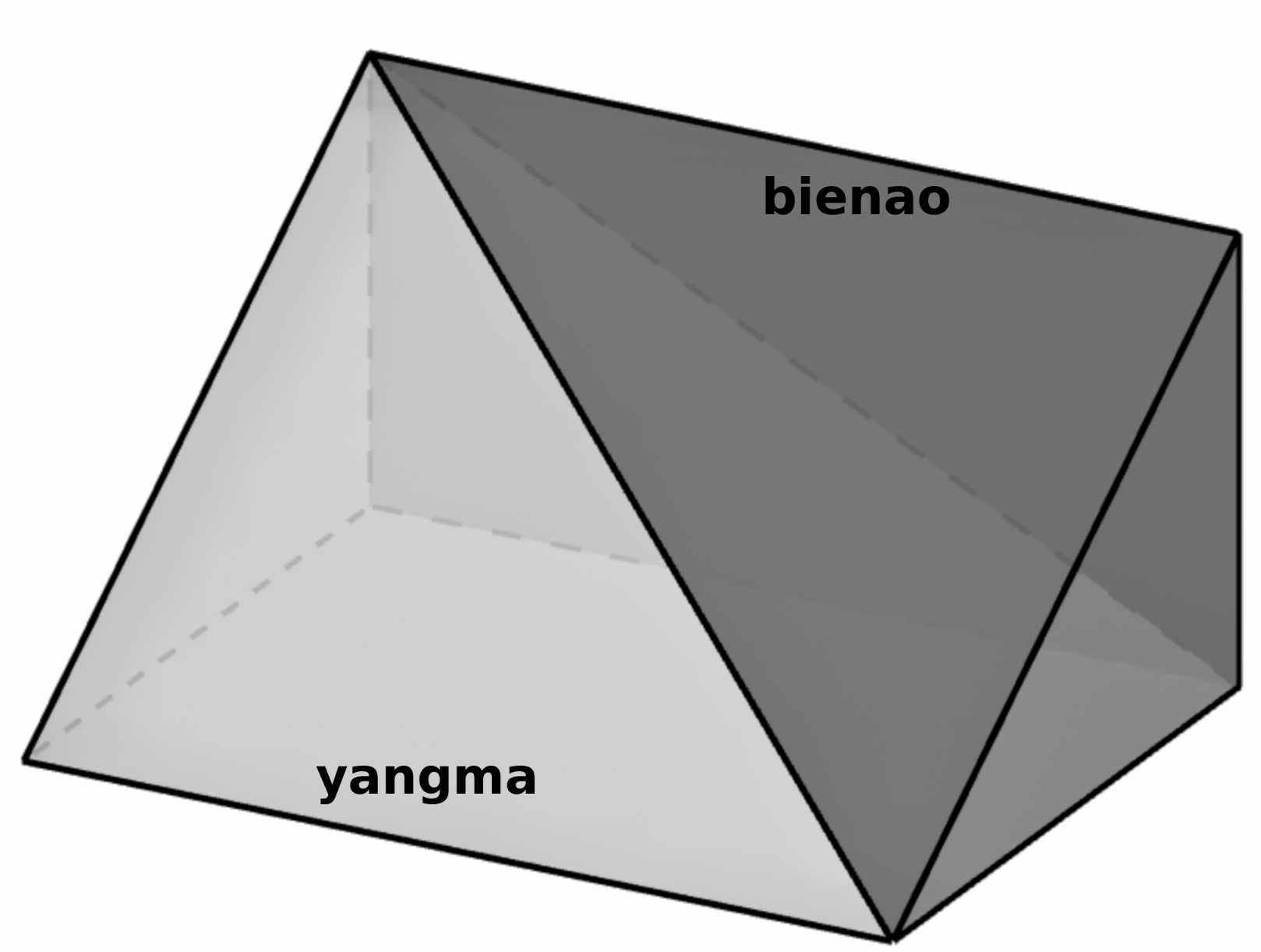
- What happens to the total volume of the remaining unaccounted yangmas and bienao as the process continues?
- What does this allow Liu Hui to conclude about the volumes of the yangma and the bienao?
- Why does this argument go beyond ordinary dissection? Explain what kind of reasoning replaces a finite cut-and-rearrange argument.
- What does it mean to say that Diophantus moved algebra away from rhetorical algebra and toward symbolic algebra?
- Problem II.8 of Diophantus’s Arithmetica asks: “Divide a given square into two squares.” Fermat read this problem in a 1670 edition and wrote a famous note in the margin. What did he write?
- State Fermat’s Last Theorem precisely. Who proved it and when?
Part 2: Reflection Questions
- The comparison between ancient Chinese elimination and modern matrices is tempting. What can such comparisons illuminate, and what can they distort?
- Fermat wrote his famous note in the margin of a copy of Diophantus. What does this suggest about how old mathematics can generate new mathematics?
- Fermat wrote hundreds of mathematical claims in letters and margins. He rarely provided proofs. His Last Theorem was unproved for 357 years. Does the difficulty of proving something make it more or less likely to be true? What does this episode tell you about the relationship between conjecture and proof in mathematics?
- Liu Hui worked during a period when many ancient texts had been destroyed by the Qin emperor’s book burnings. He wrote that he was “filling in what was missing.” How does historical destruction of knowledge affect the development of mathematics? Is mathematics lost, or does it tend to be rediscovered?
- The Nine Chapters organizes mathematics by practical problem type rather than by logical structure. Euclid’s Elements organizes mathematics by logical deduction from axioms. What does each approach make easy and what does each make hard — for a student learning mathematics, and for a mathematician trying to extend it?
Quiz Problem Rubric
| Points | Criteria |
|---|---|
| 3 | Correct answer with reasoning/work shown |
| 2 | Partially correct with some reasoning shown |
| 1 | Correct answer without reasoning/work OR significant attempt with some understanding |
| 0 | Incorrect or blank |
Notes
- For computational problems: “reasoning/work” = steps shown
- For conceptual problems: “reasoning” = explanation given
- Round partial credit up when in doubt